
Does the invisible world of microscopic organisms ignite your curiosity? Or are you curious to discover the powerful impact these tiny microorganisms have on the diseases, health, environment, and industries? Then Bachelor of Science in Microbiology is the perfect course to spark your interest. Now let’s understand the Bsc Microbiology course in detail, from subjects, top colleges to expected career profiles.
What is Bsc Microbiology?
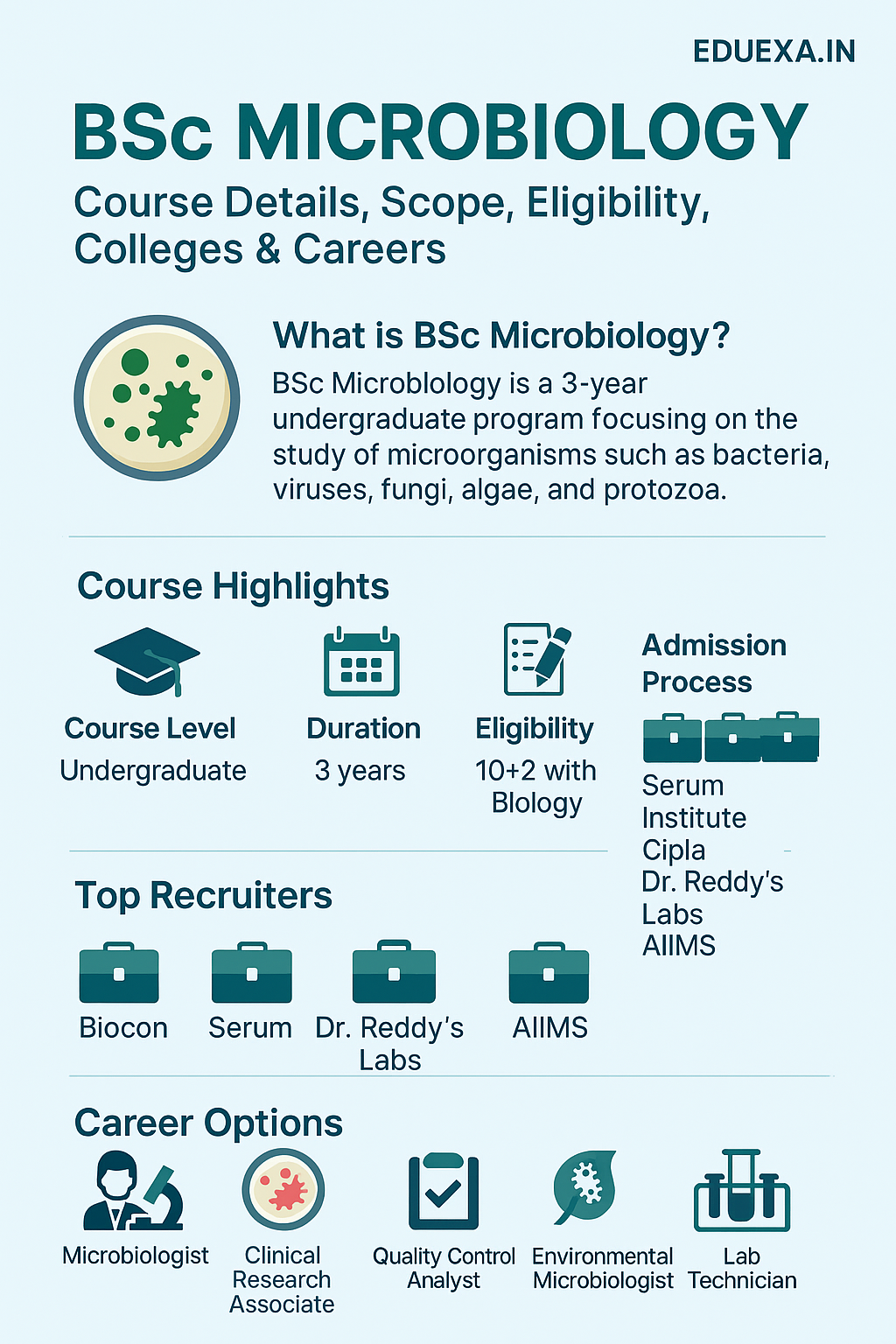
Bsc. Microbiology or bachelor of science in microbiology is a 3 Year dedicated undergraduate course to study microorganisms including bacterias, viruses, protozoans, fungi, algae etc. Microbiology is the study of microorganisms or microbes. Microbes are the tiny organisms which can not be seen from the normal eyes i.e. you need a microscope to view and study them.
This course is an integration of biology, chemistry, biochemistry, genetics, and molecular biology, and it enriches the students’ learning about microbial genetics, immunology, molecular biology, and industrial microbiology.
Relevance of Bsc Microbiology today
- It plays a vital role in combating antimicrobial resistance (AMR), a major global health issue.
- Microbes are extensively used in sustainable technologies such as biofuels, biodegradable plastics, and organic fertilizers.
- Biotechnology, pharmacology, agriculture, food industries, and climate science all rely heavily on microbial applications.
News Update
Infrastructure & Research Advancements
- AIIMS Nagpur Establishes Maharashtra’s First BSL-3 Lab
AIIMS Nagpur is set to become the first medical college in Maharashtra to host a Bio-Safety Level-3 (BSL-3) laboratory. Developed in collaboration with the National Centre for Disease Control (NCDC), this high-security lab will enable rapid detection and containment of deadly pathogens like Nipah, Zika, bird flu, and bioterrorism agents. The facility, funded under the PM-Ayushman Bharat Health Infrastructure Mission with a budget of ₹30 crore, will also train microbiologists and technicians statewide. – Times of India - Rapid ASF Detection Kit Developed in Assam
The College of Veterinary Science at Assam Agricultural University has developed a rapid antigen detection kit for African Swine Fever (ASF). Led by Dr. Narendra Nath Barman, the kit can detect ASF in pig samples within minutes using just one drop of blood, a significant improvement over traditional tests that take days. This innovation is crucial for the pig farming industry and demonstrates successful collaboration between academic research and commercial innovation
Global Microbiology Discoveries
- Evolutionary Origin of Morbilliviruses Identified
Recent investigations in wild bats and non-human primates in Brazil and Costa Rica have revealed diverse morbillivirus ecology in neotropical bats, providing evidence for host jumps and identifying an evolutionary origin for morbilliviruses in bats. - Climate Change Threatens Soil Health
A global synthesis combining meta-analysis and controlled experiments has shown that warming alters bacterial life histories, fueling the spread of antibiotic resistance genes and virulence factor genes, posing a novel threat to soil health.
Do you know which is the toughest exam in India? Discover here!
BSc Microbiology Course Highlights
| Feature | Details |
| Course Level | Undergraduate |
| Duration | 3 years (6 semesters) |
| Eligibility | 10+2 with Biology (PCB/PCM) |
| Admission Process | Merit-based or Entrance Test (varies by college) |
| Average Fees | ₹30,000 – ₹2,00,000 per year |
| Top Recruiters | Biocon, Serum Institute, Cipla, Dr. Reddy’s Labs, AIIMS, ICMR, etc. |
Subjects Covered in BSc Microbiology
The BSc Microbiology syllabus includes both theoretical and practical components. Common subjects covered in the six semesters are:
- General Microbiology
- Cell Biology
- Molecular Biology
- Microbial Physiology
- Immunology
- Genetics
- Environmental Microbiology
- Industrial Microbiology
- Food & Dairy Microbiology
- Medical Microbiology
- Virology & Parasitology
- Bioinformatics & Biostatistics
Skills You’ll Gain
- Laboratory Techniques
- Microscopy & Staining Methods
- Microbial Culture Handling
- Research & Data Interpretation
- Report Writing & Scientific Communication
- Problem-Solving & Analytical Skills
BSc Microbiology Eligibility
Having keen interest in a subject won’t get you your desired course, you need to meet specific eligibility requirements to get admission in your desired course and college. The eligibility requirements are:-
- Must have passed Class 12 or any other equivalent examination from a recognized board with an aggregate of at least 50% marks.
- Studied PCB i.e. Physics, chemistry and biology in their +2 or 12th.
- Must clear the cut-offs of the specific exams desired by the university you need admission in.
“Want to know about the top diploma courses after 12th- Read here”
Top Colleges in India Offering BSc Microbiology
Here’s a list of top institutes where you can pursue a BSc in Microbiology:
| College Name | Location | Type | Average Fees (per year) |
| St. Xavier’s College | Mumbai, Maharashtra | Autonomous | ₹7,000 – ₹8,000 |
| Fergusson College | Pune, Maharashtra | Autonomous | ₹6,000 – ₹10,000 |
| Madras Christian College (MCC) | Chennai, Tamil Nadu | Autonomous | ₹30,000 – ₹40,000 |
| Mount Carmel College | Bengaluru, Karnataka | Autonomous (Women) | ₹45,000 – ₹50,000 |
| Presidency College | Chennai, Tamil Nadu | Government | ₹2,000 – ₹5,000 |
| Christ University | Bengaluru, Karnataka | Deemed | ₹50,000 – ₹70,000 |
| Loyola College | Chennai, Tamil Nadu | Autonomous | ₹30,000 – ₹40,000 |
| Banaras Hindu University (BHU) | Varanasi, UP | Central University | ₹3,000 – ₹5,000 |
| Amity University | Multiple Cities | Private | ₹80,000 – ₹1,50,000 |
| Parul University | Vadodara, Gujarat | Private | ₹70,000 – ₹1,00,000 |
| Delhi University (DU) Colleges (e.g. Gargi, Ramjas) | Delhi | Central University | ₹5,000 – ₹8,000 |
| Punjab University | Chandigarh | Government | ₹20,000 – ₹30,000 |
| Guru Nanak Dev University (GNDU) | Amritsar, Punjab | State University | ₹15,000 – ₹25,000 |
| Sri Venkateswara College | Delhi (DU) | Central | ₹5,000 – ₹7,000 |
| MS University of Baroda | Vadodara, Gujarat | State Govt. |
✅ Tip from Eduexa: Check individual college websites for specific admission criteria and entrance tests.
BSc Microbiology Admission 2025: Top Entrance Exams Syllabus
Do you want admission in the best college in India for Bachelor of Science in Microbiology? You won’t get it for free, I mean you have to grab your seat by showing relevant skills in the entrance exams. Common entrance exams for admissions in top colleges include CUET, CUCET, LPU NEST, etc. Apart from these tests, some of the colleges might have their own specific entrance test that you need to qualify. The exam syllabus is the next important thing to see after filling the application form for any entrance exams. Interested candidates can check out the table below to have a brief look at some popular BSc Microbiology exams and their syllabus for entrance exams:
| Entrance Exams | Syllabus |
| CUET | The syllabus of CUET UG is divided into 3 sections that include Language, domain-specific subjects, and General Tests. |
| CUCET | The syllabus of CUCET consists of core subjects such as physics, chemistry, biology and maths accompanied by aptitude tests. |
| LPU NEST | The syllabus of LPU NEST comprises topics such as physics, chemistry, biology, maths and english. |
Bsc Microbiology Colleges Abroad
| Country | University | Program Name | Tuition Fee (Approx/Year) | Eligibility Criteria | Key Highlights |
| USA | Harvard University | B.A. in Molecular and Cellular Biology | $54,000 | SAT/ACT, TOEFL/IELTS, GPA, SOP, LOR | World-leading research in virology and immunology |
| USA | UC Berkeley | B.A. in Microbial Biology | $45,000 | TOEFL/IELTS, GPA; SAT optional | Advanced microbial genetics, environmental microbiology |
| USA | University of Wisconsin–Madison | B.S. in Microbiology | $38,000 | TOEFL/IELTS, Science background | Oldest and reputed microbiology program in the U.S. |
| Canada | University of British Columbia (UBC) | B.Sc. in Microbiology and Immunology | CAD 40,000 (~₹24L) | IELTS 6.5+, high 12th-grade marks | Strong focus on immunology and molecular microbiology |
| Canada | McGill University | B.Sc. in Microbiology and Immunology | CAD 29,000 (~₹17L) | IELTS 6.5+, Biology/Chemistry in 12th | Linked with hospital-based research |
| UK | University of Oxford | B.A. in Biological Sciences (Microbiology elective) | £39,000 (~₹41L) | A-levels/CBSE + IELTS 7.0+, entrance test | Elite research and academic reputation |
| UK | University of Glasgow | B.Sc. (Hons) Microbiology | £25,000 (~₹26L) | 12th grade science, IELTS 6.5+ | Russell Group member; strong in infection biology |
| UK | University of Leeds | B.Sc. Microbiology | £25,500 (~₹27L) | IELTS 6.5+, Biology + Chemistry | Great lab facilities and research culture |
| Australia | University of Melbourne | Bachelor of Science (Microbiology Major) | AUD 45,000 (~₹25L) | IELTS 6.5+, 12th-grade science | Top Australian uni; internships in biomedical labs |
| Australia | University of Queensland (UQ) | B.Sc. in Microbiology | AUD 43,000 (~₹24L) | IELTS 6.5+, science stream | Strong in agricultural, food and environmental microbiology |
| Germany | University of Göttingen | B.Sc. Biology (Microbiology track) | Free (fee ~€300/semester) | German proficiency or English (varies); 12th with science | Tuition-free; international research programs |
| Singapore | National University of Singapore (NUS) | B.Sc. in Life Sciences (Microbiology specialization) | SGD 38,000 (~₹23L) | IELTS/TOEFL, top grades in Biology and Chemistry | Ranked #1 in Asia for life sciences |
Career Options After BSc Microbiology
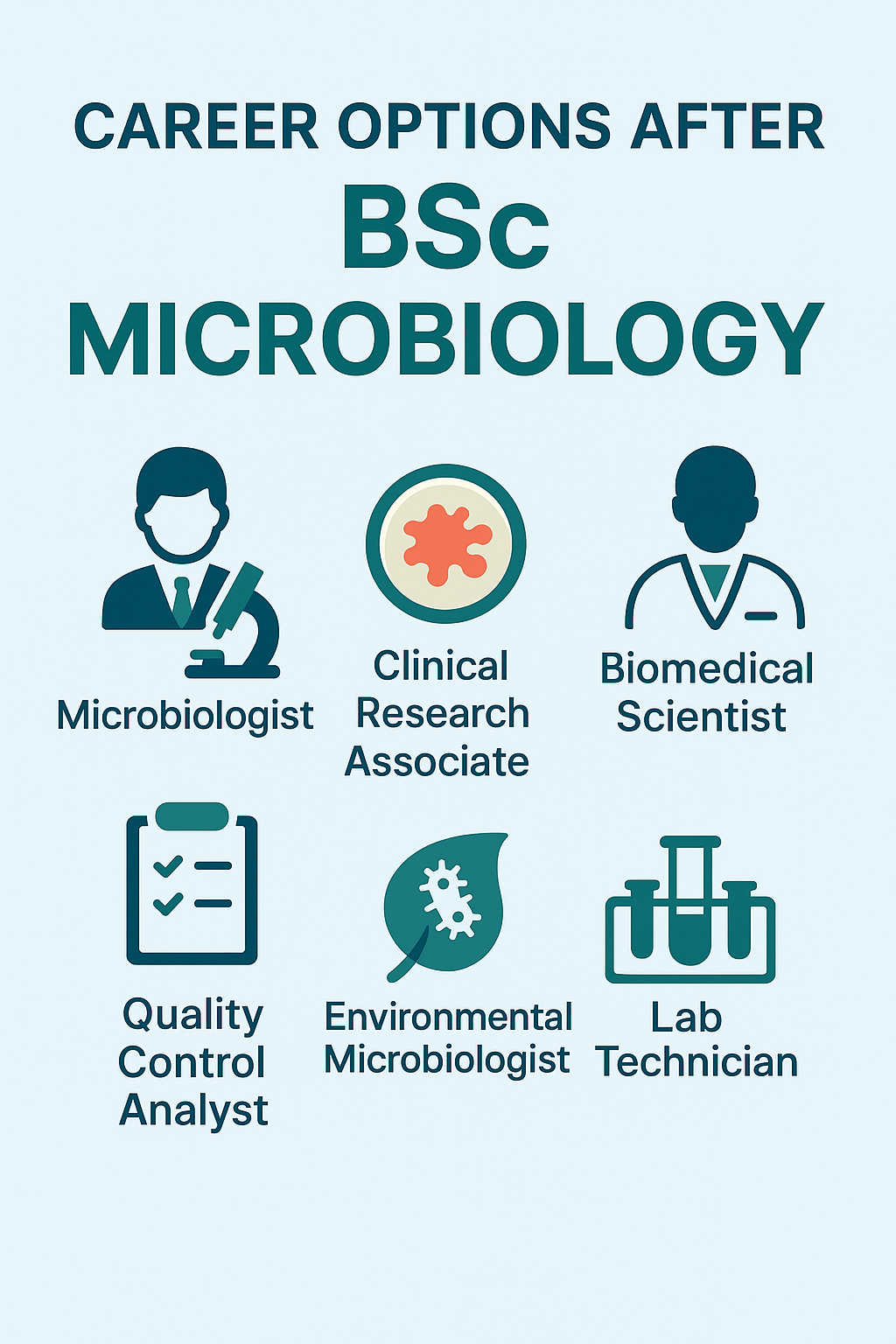
The scope of BSc Microbiology is vast, both in India and abroad. Some popular job roles include:
Microbiologist
As a microbiologist, you work in hospitals, labs, or pharmaceutical companies to identify and study pathogens.
Clinical Research Associate
Clinical research associate is involved in testing and documentation for drug trials and vaccine development.
Quality Control Analyst
Who do you think is responsible for ensuring microbial standards in food, water, pharmaceuticals, or cosmetics, so that no consumer is harmed or affected by low quality? It is the role of Quality Control Analyst.
Environmental Microbiologist
Study in microbiology or Bsc Microbiology does not just have its application in labs and health sector but it also has significant relevance in studying environmental issues. Environmental Microbiologists study microbes in soil, water, or air to address pollution and sustainability issues.
Lab Technician
One of the common roles taken by students after pursuing their Bsc Microbiology is Lab Technician. A lab technician assists in sample testing, analysis, and lab management.
Higher Education & Research
You can further enrich yourself with specialised study in a module or subject by pursuing MSc, MPhil, or PhD in Microbiology, Biotechnology, or Life Sciences.
Government Jobs After BSc Microbiology
I know no matter what course we join in, we always look for government opportunities/ roles being offered because “Sarkari Naukri ki baat hi alag hai”. Government Job vacancies open up in different sectors across subjects and Bsc microbiology is no exception. As a microbiology graduate, you can apply for roles in:
- ICMR (Indian Council of Medical Research)
- DRDO
- Food Corporation of India (FCI)
- Public Health Departments
- Forensic Labs
- Government Hospitals
“Also Read about SSC CGL exams”
Salary After BSc Microbiology in India
| Role | Average Salary (per annum) |
| Microbiologist | ₹3 LPA – ₹6 LPA |
| QC Analyst | ₹2.5 LPA – ₹5 LPA |
| Lab Technician | ₹1.8 LPA – ₹4 LPA |
| Clinical Research Associate | ₹3.5 LPA – ₹6.5 LPA |
Note: Salaries increase significantly with postgraduate qualifications and experience.
Is BSc Microbiology a Good Career Option?
Absolutely! People and countries have realised the importance of sufficient research and investment in study of microbes after the COVID outbreak. With the rise in demand for healthcare, food safety, biotechnology, and environmental conservation, microbiology is a future-proof field. A BSc in Microbiology offers:
- High Employability: This course offers high employability in both the private and government sector.
- Global Opportunities: The career options and opportunities for microbiologists and related roles are not limited to India. Other developed countries like the USA, Uk etc offers many lucrative opportunities especially for research and development.
- Scope for Innovation & Research: Global concern over antimicrobial resistance (AMR) has created a demand for microbial researchers and public health experts.
- Diverse career pathways: Industrial microbiologists are hired in biotech and pharma companies to design microbial processes for Antibiotics, Vaccines, Enzymes, Biofuels etc. You can work in bioprocessing, fermentation, R&D, and quality assurance.
Final Thoughts
Whether you’re aiming for a research career, a job in the pharma industry, or higher education in biosciences, BSc Microbiology provides a solid launchpad. Choose the right college, build strong lab skills, and stay updated with new scientific advancements.
Explore the world of microorganisms — and discover how small things can lead to a big career.
📲 Need Help Choosing the Right College or Career Path in Microbiology? Stay updated with Eduexa’s latest posts and updates for perfect guidance and right information.
FAQs: BSc Microbiology
Q1. What is B.Sc microbiology about?
Bsc microbiology is a 3 year undergraduate program based on study of pathogens and microbes including bacteria, viruses, fungi, protozoans and algae.
Q2. Can I do MBBS after BSc Microbiology?
Yes, you can appear for NEET and pursue MBBS if you meet the eligibility criteria.
Q3. What are the higher study options after BSc Microbiology?
You can pursue MSc Microbiology, MSc Biotechnology, MTech in Life Sciences, or even prepare for CSIR-NET or GATE.
Q4. Is BSc Microbiology better than BSc Biotechnology?
It depends on your interests. Microbiology focuses on microorganisms; Biotechnology is broader, involving genetic engineering and industrial applications.